glow academy
Remove self-tanner
6 July 2026 · MARC INBANE · 2 min read
" Avoid harsh scrubbing, abrasive sponges and chemical bleaching agents ”

A patch, a streak or a layer that has turned out too dark: luckily, self-tanner can be removed in a controlled way. Because self-tanner only affects the outermost layer of the skin, as explained in the complete self-tanning guide, it can be removed gradually with a gentle approach. Harsh scrubbing or chemical products are counterproductive and can damage your skin.
How do you remove self-tanner?
You remove self-tanner by first softening the skin in a warm bath or shower, then gently exfoliating in circular motions with an oil-free scrub or an Exfoliating Mitt. Never scrub harshly and do not use aggressive chemicals.
The warmth helps loosen the dead, coloured skin cells, after which a gentle scrub can remove them in a controlled way without irritating the healthy skin underneath. Work in calm, circular motions and repeat the process after a day if needed, instead of scrubbing too hard in one go. Afterwards, apply a generous layer of moisturiser to restore the skin’s moisture balance.
How do you remove self-tanner from your hands?
Wash your hands thoroughly with soap immediately after application, paying extra attention to the fingertips, knuckles and edges of the nails. If the colour has already developed, gently exfoliate your hands with an oil-free scrub or rub the area with a slice of lemon to help loosen the discolouration. Hands and palms are classic problem areas, because the dry skin there picks up colour quickly. The combination of warm water, a mild scrub and, if needed, a little lemon juice helps remove the discolouration effectively. Prevent this next time by always using a Tanning Glove.
How do you correct patches and streaks?
Target individual patches or areas that are too dark with a damp Exfoliating Mitt or an oil-free scrub, only on the affected area itself. Blend out the edges so no new transition line appears.
A patch is almost always caused by a dry area that has absorbed too much colour, or by a streak around a transition area. Treat only the area that is too dark and, if needed, apply a thin, even layer afterwards to even out the colour difference. To prevent this next time, read the complete step-by-step routine in the guide on applying self-tanner without streaks.
How to fix dark patches or streaks on your legs
Dark self-tanner patches on your legs, often around the knees and ankles, can be corrected by softening those areas under a warm shower and then using a mild scrub directly on them. The dry skin in those areas has held on to too much colour.
Because the skin around your joints is drier, self-tanner tends to develop darker there first. Treat those areas separately and moisturise them well afterwards. For the right technique next time, see the guide for legs.
What not to do when removing sunless tan
Avoid harsh scrubbing, abrasive sponges and chemical bleaching agents. These damage your skin barrier and can cause red, irritated patches, while not making the colour disappear any faster.
Self-tanner sits in the outermost layer of the skin and fades as that layer is naturally and gently exfoliated. Patience and repetition work better than force. An oil or oil-based product can actually help loosen the colour, unlike when maintaining your tan, where oil is best avoided.
€ 14,95

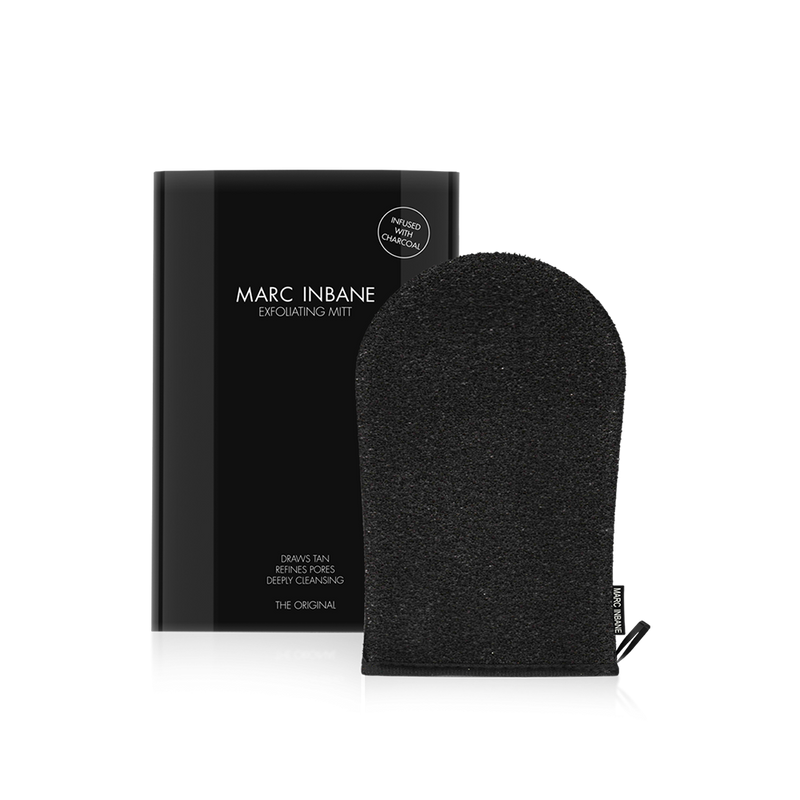
Exfoliating Mitt
Two-sided mitt with a soft and slightly rougher side
€ 39,95

Black Exfoliator
A richly moisturizing black facial scrub with natural carbon
€ 9,95

Glove
For an even application of tanning on the body
In this article